Understanding AI in Epicor: Epicor Prism and the Rise of Agentic Automation.
How Artificial Intelligence Is Reshaping ERP Systems from Data Visibility to Operational Execution.

Gonzalo Nuñez
Chief Technology Officer
Enterprise Resource Planning systems have always been at the center of operational efficiency. Over the past decade, ERP platforms have evolved from transactional systems into intelligence-driven environments capable of supporting better, faster decision-making.
More recently, artificial intelligence has accelerated this evolution. Organizations are no longer looking at ERP systems solely as systems of record, but increasingly as systems of insight and action.
However, as AI capabilities expand, so does confusion. Not all AI embedded in ERP systems serves the same purpose. Some capabilities are designed to enhance visibility and support decision-making, while others automate processes and execute tasks.
Understanding this distinction is critical for organizations evaluating how to leverage AI within their Epicor environment.
AI in Epicor Today: More Than One Approach.
Today, AI within Epicor ecosystems can be broadly understood in terms of two complementary approaches.
- Embedded AI within the ERP platform, represented by Epicor Prism, focuses on enhancing the user experience through insights, recommendations, and predictive capabilities.
- AI-powered automation platforms, such as Fluent AI, extend ERP capabilities beyond the system itself, enabling process automation, system orchestration, and cross-platform execution.
These approaches are not mutually exclusive. In fact, they address different layers of the operational stack and, when used together, can significantly enhance business performance.
What is Epicor Prism?
Epicor Prism represents Epicor’s native approach to integrating artificial intelligence directly into its ERP platform.
Its primary objective is to improve how users interact with data by providing:
- Contextual insights
- Predictive analytics
- Intelligent recommendations
- AI-generated summaries
By embedding AI into the ERP interface, Prism helps users better understand what is happening within their organization and identify areas that may require attention.
For example, Prism can assist finance teams by highlighting anomalies, support operations teams by identifying trends in production data, or help leadership teams gain a clearer view of performance metrics.
In this sense, Prism enhances visibility and supports more informed decision-making. It represents an important step forward in making ERP systems more intelligent and user-friendly.
What is Fluent?
Fluent is an AI-powered automation platform designed to work alongside Epicor and other enterprise systems.
While embedded AI focuses on understanding and interpreting data, Fluent focuses on acting on that data.
Fluent enables organizations to automate workflows, synchronize data across systems, and execute processes with minimal manual intervention. Its capabilities include:
- Automated invoice data extraction and entry
- Data synchronization between ERP and CRM systems
- Messaging automation based on ERP events
- AI-driven analytics powered by autonomous agents
- Integration across multiple business platforms
Rather than requiring users to manually interpret insights and take action, Fluent allows organizations to define workflows that are triggered automatically based on events, conditions, or business rules.
This represents a shift from insight-driven operations to execution-driven operations.
Key Differences Between Prism and Fluent:
Understanding how these two approaches differ is essential for organizations evaluating their AI strategy.
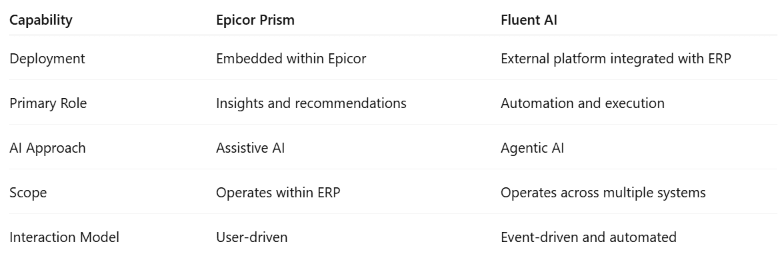
Epicor Prism enhances how users interact with data inside the ERP. Fluent extends the ERP by enabling automated actions across systems.
From AI Insights to AI Execution:
Many organizations today are already benefiting from improved visibility through AI-powered insights. However, insight alone does not guarantee operational efficiency.
In traditional workflows, even when insights are available, actions still depend on manual intervention. A user must interpret the information, decide what to do, and execute the required steps across one or more systems.
This introduces delays, increases the risk of errors, and limits scalability.
The next stage in the evolution of ERP systems involves closing this gap between insight and execution.
Instead of stopping at identifying what should be done, organizations are increasingly seeking ways to ensure actions are carried out automatically, consistently, and in real time.
This is where agentic AI becomes relevant.
What is Agentic AI in ERP?
Agentic AI refers to systems that can not only analyze data, but also take action based on predefined logic, triggers, and learned patterns.
Within an ERP context, this means moving beyond dashboards and recommendations to systems that can actively execute business processes.
Examples of agentic AI in ERP environments include:
- Automatically extracting and posting invoice data into the ERP
- Triggering customer or supplier communications based on transaction events
- Synchronizing data between ERP and CRM platforms without manual input
- Updating records and initiating workflows based on predefined conditions
These capabilities reduce the need for manual intervention and allow organizations to operate more efficiently at scale.
How Prism and Fluent Work Together:
It is important to emphasize that Epicor Prism and Fluent AI are not competing solutions. They address different aspects of the same challenge.
Epicor Prism focuses on understanding and interpreting data. It helps organizations identify trends, detect anomalies, and make informed decisions.
Fluent focuses on executing processes. It enables organizations to automate workflows, connect systems, and ensure that actions are carried out consistently.
When used together, they support a more complete AI-enabled ERP environment.
Prism can surface insights that highlight opportunities or issues. Fluent can then act on those insights by triggering workflows, automating processes, and ensuring that tasks are completed without delay.
This combination allows organizations to move toward a more integrated and responsive operational model.
Practical Use Cases:
The distinction between insight and execution becomes clearer when looking at practical applications.
- Invoice Processing
Prism can help identify discrepancies or anomalies in financial data. Fluent can automate the extraction of invoice information, validate it, and post it directly into the ERP system. - Customer Communication
Prism can summarize customer interactions and highlight key information. Fluent can trigger automated messages to customers or suppliers based on specific events within the ERP. - Sales and Revenue Insights
Prism can identify trends and highlight opportunities within sales data. Fluent can synchronize this information with CRM systems and initiate follow-up actions or workflows.
In each case, Prism enhances understanding, while Fluent enables execution.
What This Means for Epicor Customers:
For organizations using Epicor, the introduction of AI capabilities represents a significant opportunity. However, it also requires a clear understanding of what each tool is designed to achieve.
AI should not be viewed as a single feature or capability. Instead, it should be understood as a combination of complementary approaches that together enhance both visibility and execution.
Organizations evaluating AI within their ERP environment should consider:
- How insights are generated and presented
- How decisions are translated into actions
- How systems communicate and share data
- How manual processes can be reduced or eliminated
By addressing both the insight layer and the execution layer, organizations can unlock greater efficiency and scalability.
The Future of AI in ERP Systems:
The direction of ERP systems is clear. Organizations are moving toward environments that are more connected, more automated, and less dependent on manual processes.
AI will continue to play a central role in this transformation by:
- Enhancing how users interact with data
- Automating routine and complex workflows
- Enabling systems to operate more independently
- Connecting multiple platforms into a unified ecosystem
As these capabilities mature, ERP systems will increasingly function as intelligent operational hubs rather than passive data repositories.
Conclusion:
Artificial intelligence is reshaping how organizations use ERP systems, but not all AI capabilities serve the same purpose.
Epicor Prism represents an important step in enhancing how organizations understand their data. It improves visibility, supports decision-making, and makes ERP systems more intuitive.
Fluent AI builds on this foundation by enabling organizations to act on that data. It automates processes, connects systems, and reduces the need for manual intervention.
Organizations that combine intelligent insights with automated execution are better positioned to improve efficiency, reduce operational complexity, and scale effectively in an increasingly competitive environment.
Frequently Asked Questions
The first steps typically include: Identifying high-friction processes Evaluating existing ERP capabilities Determining where AI can add the most value Prioritizing use cases such as invoicing, reporting, or data synchronization Starting with targeted use cases allows organizations to demonstrate value quickly before expanding AI adoption.
Yes, AI integration can significantly improve forecasting accuracy. By analyzing broader datasets and continuously learning from new information, AI models can refine predictions over time. This leads to more reliable forecasts and better alignment between planning and execution.
Return on investment from AI in ERP systems varies depending on the scope of implementation, but organizations commonly see value in three areas: Increased productivity through automation Reduced operational costs Improved decision-making accuracy In many cases, ROI is realized through time savings, process efficiency, and improved resource allocation rather than a single measurable metric.
AI improves financial forecasting by incorporating more data points and identifying trends that may not be visible through traditional methods. This allows organizations to: Generate more accurate forecasts Adjust projections in real time Identify risks and opportunities earlier When paired with automation, forecasting improvements can also trigger proactive actions, such as budget adjustments or operational changes.
Technology Coast Partners follows a structured approach to AI implementation: Assess current systems and processes Define strategic objectives Design tailored AI and automation solutions Implement and integrate across platforms Provide ongoing support and optimization This ensures that AI initiatives are aligned with operational goals and deliver long-term value.
Scalability depends less on a single ERP system and more on how AI is implemented across the ecosystem. Cloud-based ERP platforms like Epicor Kinetic provide a strong foundation for scalability. When combined with AI-driven automation platforms, organizations can scale operations more effectively by reducing manual processes and enabling real-time data flows across systems. A scalable AI strategy typically includes: A flexible ERP platform Integrated AI capabilities Automation layers that can adapt to evolving business needs
The most effective AI tools for ERP automation typically fall into two categories. The first category includes embedded AI capabilities within ERP platforms, such as Epicor Prism, which enhance data visibility, provide recommendations, and support decision-making. The second category includes AI-powered automation platforms, such as Fluent AI, which extend ERP systems by enabling workflow automation, data synchronization, and cross-system orchestration. Organizations often achieve the best results by combining both approaches, using embedded AI for insights and external platforms for execution.
AI integration options generally include: Native AI capabilities within the ERP Third-party AI platforms for automation and orchestration Custom integrations tailored to specific business processes The right approach depends on the organization’s goals, existing infrastructure, and level of complexity.
AI enhances predictive analytics by analyzing large volumes of historical and real-time data to identify patterns and trends. In ERP systems, this can improve: Demand forecasting Production planning Financial projections Inventory optimization Embedded AI tools can surface predictions and insights, while automation platforms can act on those predictions by triggering workflows or updating systems automatically.
AI improves ERP efficiency by reducing manual effort, accelerating workflows, and improving data accuracy. This includes: Automating routine processes Enhancing data consistency across systems Reducing delays in task execution Enabling faster and more informed decision-making The combination of AI-driven insights and automated workflows leads to more streamlined operations.
Getting started with AI in ERP typically involves a structured approach: Assess current processes and identify inefficiencies Define clear objectives for AI adoption Evaluate available AI capabilities within the ERP Identify opportunities for automation and integration Implement solutions in phases, starting with high-impact use cases Working with an experienced partner can help ensure a more effective and scalable implementation.
Yes, AI can significantly reduce operational costs when implemented effectively. Cost reductions typically come from: Automating repetitive manual tasks Reducing data entry errors Improving process efficiency Minimizing delays in decision-making By combining AI insights with automated execution, organizations can streamline operations and reduce the need for manual intervention.
Technology Coast Partners enhances ERP systems by combining deep ERP expertise with advanced AI and automation capabilities. This includes: Identifying opportunities for AI-driven improvements Implementing automation workflows across systems Integrating ERP with CRM and other platforms Supporting organizations in scaling their AI initiatives The focus is on aligning technology with business objectives to deliver measurable operational improvements.